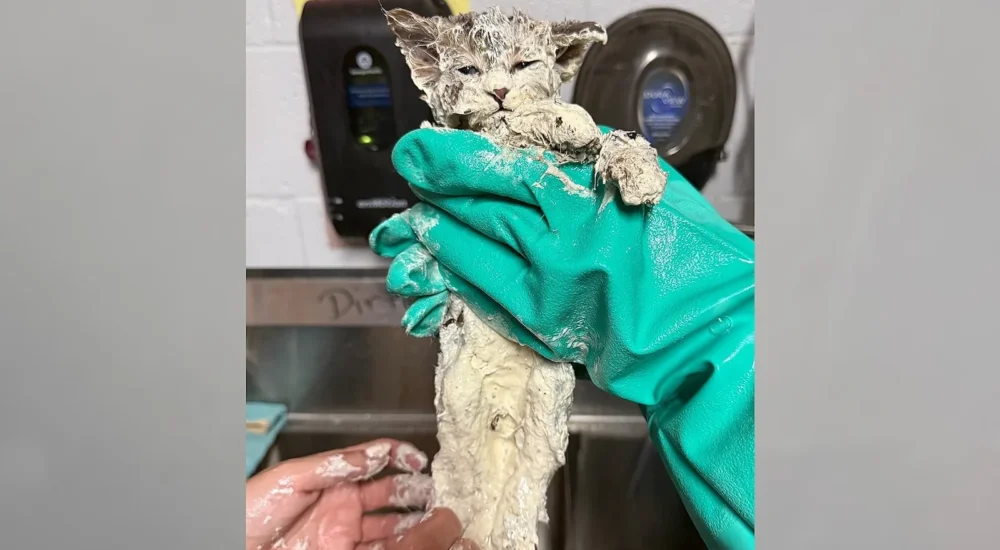
NORTH TEXAS, TX — A 6-week-old kitten rescued from a vat of industrial glue now has a name, and the Humane Society of North Texas is calling him Elmer. The tiny animal arrived in critical condition after a good Samaritan brought him in covered in adhesive so thick it left him unable to eat, drink, or care for himself properly.
Staff members quickly moved him into treatment and began searching for a safe way to remove the glue from his fur. What followed was a long, careful rescue effort that turned into a hopeful recovery story for the kitten and the team caring for him.
A rescue that began with an urgent call for help
Cassie Davidson, senior director of marketing, communications and public relations for the Humane Society of North Texas, said the organization did not hesitate once the kitten arrived. The response was immediate because the animal was severely dehydrated and in critical need of care.
In a Facebook post shared April 12, the humane society said the glue had left Elmer unable to manage basic needs on his own. The post helped explain why staff treated the case as an emergency from the start. The kitten was tiny, fragile and completely dependent on people to give him a chance at survival.
Davidson described the response as all hands on deck, with staff members focused on getting him stable before worrying about the bigger cleanup job ahead. That first stage was less about a dramatic rescue moment and more about careful, constant attention to a kitten who had almost no reserves left.
Canola oil became the key to loosening the adhesive
The humane society’s medical staff tried several solvents before finding a method that worked best: canola oil. According to Davidson, the oil helped break down the industrial-strength glue stuck to Elmer’s body and made it possible to begin removing the buildup safely.
Four staff members then spent about seven hours massaging roughly two gallons of canola oil into the kitten’s fur while occasionally feeding him. It was slow, hands-on work, and every step had to be done carefully because of how much glue remained on his body.
After that, the team wrapped gauze around Elmer so the oil could continue soaking into the fur. The goal was to keep loosening the adhesive without causing more stress to the kitten, who was already weak from dehydration and the long ordeal.
Seven hours of hands-on care brought the first signs of recovery
Davidson said the cleanup was labor intensive, but the effort paid off as more glue came off. As the kitten slowly shed the adhesive, he began to perk up and regain some of his energy.
That change mattered just as much as the physical cleaning. Davidson said Elmer seemed to find his spark again once the worst of the glue was removed, a hopeful sign after he had arrived in such rough shape.
The transformation was not immediate or simple. It took patience, repeated care and a staff willing to keep going for hours at a time. But by the end of that stretch, the humane society had made major progress toward getting him back on his feet.
Elmer still needs regular oil baths before adoption
Even after the initial rescue work, Elmer still has some glue left in his fur. The humane society and foster team plan to keep caring for him, including regular oil baths to help remove what remains.
That means his recovery will continue in stages rather than all at once. Staff expect him to stay under close supervision until he is older and stronger, with the focus now on comfort, healing and steady improvement.
Once he is ready, the humane society expects to place him up for adoption. For now, the kitten’s daily routine is about recovery rather than a permanent home, but the organization says he is responding well to the attention.
Why the tiny kitten’s personality has already won over caregivers
Despite everything he has gone through, Davidson said Elmer mainly just wants love. That simple detail has helped shape the tone of his recovery, which has become as much about tenderness as treatment.
The humane society’s account of his progress has resonated because it combines urgency with a happy ending in the making. A kitten found coated in glue is now safe, cared for and steadily improving because people acted quickly and kept working until he started to bounce back.
For the staff and foster caregivers now looking after him, the next steps are straightforward but important: keep easing the remaining glue out, keep him healthy, and get him ready for the chance to live the normal kitten life he was nearly denied.
Real, uplifting stories from across America – GCHS Eagle's Eye.