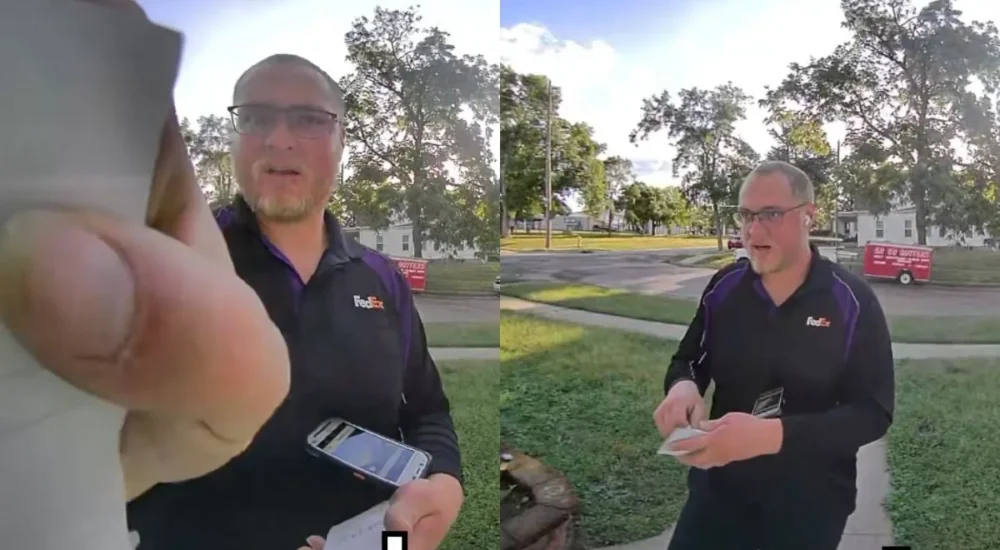
MARYLAND, MD — A Maryland Amazon driver is getting a wave of support after posting a TikTok about a delivery note that told him to skip a gravel driveway, park by the mailbox, and carry a package to the front door.
The driver read the instruction aloud in the video and reacted with frustration after seeing the request. The note said the walk was 350 feet, and the caption suggested the route was even more punishing because it went up and back down a steep hill.
Viewers quickly turned the clip into a larger conversation about delivery expectations, customer convenience, and how much extra effort drivers should reasonably be asked to take for a single drop-off.
What the delivery note asked him to do
The instruction at the center of the video was simple on paper, but far more demanding in practice. The note told the driver not to use the gravel at the house, to leave the vehicle at the mailbox, and to walk the package to the front door.
According to the message he read aloud, that trip would cover about 350 feet. In the caption, he added that the route was not just long, but steep, describing it as 350 feet uphill and 350 feet back down a slope he characterized as nearly vertical.
That detail mattered to viewers because it shifted the conversation from a short walk to a physically demanding climb. For many commenters, the issue was not simply distance, but the combination of distance, incline, and the expectation that the driver would carry the package by hand the whole way.
The TikTok reaction favored the driver
Most of the responses under the video backed the driver rather than the customer. Many commenters said the instructions went beyond what they would consider fair for a delivery stop and argued that a request like that should not be treated as routine.
One commenter wrote that customers who expect that kind of treatment “don’t get a delivery,” adding that those buyers should pick up the package themselves. That sentiment echoed throughout the discussion as viewers reacted to the uphill route and the refusal to use the driveway.
Some users also focused on the length of the walk itself, comparing it to the distance of a football field. The point, for them, was that this was not a quick favor from the mailbox to the porch, but a substantial hike that would take time and effort on every stop.
Some viewers suggested a different solution
A smaller group of commenters tried to offer practical alternatives for the customer. One blunt suggestion was to get a PO box if vehicles could not be driven up to the house, framing that as a better fit than making a delivery driver handle the entire burden.
That response reflected a broader theme in the comments: convenience has limits. Several viewers argued that when a property is difficult to access, the person expecting the delivery may need to adapt rather than leave the hardest part of the trip to the worker.
At the same time, the discussion did not turn entirely hostile toward the homeowner. A few people treated the gravel-driveway concern as understandable in its own right, saying they could see why someone might want to avoid driving on loose stones that could get damaged or rutted.
Other drivers said the story sounded familiar
The clip also resonated with delivery workers who said they had faced similarly extreme requests. One commenter said a note that same day asked a driver to ring the bell, get let inside, and carry a package all the way to the master bedroom.
Those kinds of responses helped broaden the conversation beyond one Maryland address. Instead of being treated as a single unusual complaint, the video became a place for drivers to compare notes about the most demanding instructions they have seen on the job.
For many of them, the bigger issue was not only the physical labor but the assumption behind it. The requests described in the comments suggested a growing tension between what customers want at the door and what delivery workers are prepared, or expected, to do after arriving.
The debate turned to reading delivery instructions
Not every comment was focused on the hill or the driveway. Some viewers used the video to ask a larger question about delivery habits and whether drivers always read the instructions before deciding a package cannot be delivered.
That concern pulled the discussion in a different direction, toward accountability on both sides of the delivery process. For customers, instructions are meant to explain how to reach a home. For drivers, commenters suggested, the note may determine whether a package makes it to the door at all.
Even so, the strongest reactions remained centered on the physical reality of the route in the video. The combination of gravel, distance, and steep terrain made the request feel excessive to many viewers, who saw the driver’s complaint as a reasonable response rather than an overreaction.
Why the clip struck a nerve with viewers
Part of the video’s appeal was that it tapped into a familiar frustration about service work: how much extra effort should one person reasonably be expected to give for another person’s convenience?
The Maryland driver’s rant resonated because the ask was easy to understand. Park far away, avoid the driveway, and carry the package uphill. The simplicity of the request made it easy for viewers to judge, and many of them concluded that the burden had gone too far.
In the end, the clip became more than a complaint about one delivery. It turned into a small online referendum on courtesy, labor, and the line between a reasonable accommodation and a demand that a worker do far more than the job usually requires.
Real, uplifting stories from across America – GCHS Eagle's Eye.